
Dispatches | Editor’s Note | June 9th 2020
Dear Reader,
The kettle whistle blows hard, a quick flzz of steam. Turn a page until the book is completed and my coffee mug is empty. Glance at the electronic glow of my phone. News. Emails. Mildly irritating as ever. I’ve taken to breakfasting outside. I use the garden, in its early hours, as a kind of easy motivation into the day ahead.
I notice things again. The grey squirrels, early from their drey, are fussing at the garden’s rear wall. The bees, in a mindful thrum, are held tightly, if possessively, to the new flowers along the low bed. As the squirrel exists, the wood-pigeons return. Elsewhere, along the high brickwork, the poet’s jasmine is fully-headed and green and smells of something sweetly bottled. I hang a new feeder and within a day a woodpecker is nosing it. The wildlife, though easy tempered, has slowly, if by day, moved up the garden to the patio where lay our herbs – the curry, the lemongrass, the mint. It’s abundantly green and fussily scented up there, too. The garden is full of over-excited ambiance. Will we have an Indian summer?
Mostly holed-up, people turn to old tricks for amusement, rest and replenishment: the usual of baking, gardening, reading and/ or self-refinement. Our priorities are changing too; for some this seems invisible, and for others quite abruptly. Time is just slow enough to be noticeable and it demands you answer it.
It’s near-season for homemade garden-varieties – things to eat, I say, often taste better from the garden. We ready beetroot to jar and pickle. And mint, we shear in volumes for garnish. Its fresh smell rubs on the thumbs. I parse the other patio-potted herbs to study how it can change the usual-usual of the kitchen scenery. There goes a pleasant hour of thinking slowly; nestled pleasingly into a timeless moment in-between gardening and cooking.
Since my last update, lockdown had eased slightly, allowing for greater interaction with the world beyond our house. We used the weekends, at the end of May and early June, to continue our new tradition of walking – long, ambitious tramps through the countryside. Often this involved a discrete bridleway, followed by a long corridor of overgrowth and, importantly, an ambiguous sense of destination. Here’s my record of those footslogged Saturdays.
May 23. | Notes on Forest Mere.
Things get steep, the air tightens. We trek the local ranges, a shortcut of sorts, which is occasionally a training ground for the military and one that weekenders visit for casual exercise every so often. Today the lanes were open. In heavily wooded areas the air feels damp. The trails – which fork, split, bend and swerve – are often uneven, long and unforgiving. It drops and rises often too. From the slight elevations, the peaking hillsides, the scenery deepens and reveals a steady horizon.
It takes, by my estimation, an hour before we break from the path and rest to the open views from our favourite vantage point. The weather had greyed and cooled. Thunder drums in the belly of grey clouds behind. We don’t rest long.
In the much heavier parts of the forest, the thunderheads turn and sail above the canopy, but the rain can’t get in. We steady our path and continue our walk; conversation is effortless and happy.
The skies turn quickly to roll out a brilliant sun; the weather experiences moods like a person. We reach a high bank, over its manicured trees a lane unfolds to a distant manor house. We notice the silver lakes, in number. I haven’t been here before despite living so close-by.
We’re possibly two or three hours deep into our walk, which has been mindful. We’ve reached a preserve of nature that feels like a Trust. Walled lanes of purpled rhododendron unfold. This flower, here, feels ubiquitous – so all-over, inescapable, and inseparable from this place’s sense of beauty.
Out through Forest Mere, a brilliant isolation came upon us: the high and private walls of nature are all around. At the end of the lane, like punctuation, a rusted statue reminds me of the former life of this place. Not far away, the orchard is bare. I can taste the apples.
May 30. | On Steep.
There is, by now, always an early anticipation to these long walks. Though I use the idea of “walking” loosely. It’s an in-between thing: walking stimulates thinking; conversation is always liveliest; mental rest and activity is healthiest; the sense of pace comes back to me. I recall John-Lewis Stempel’s earth-wise book The Wood and how nature is restful. Often the timing of a book makes it everything.
Westward, our trail abounds. It’s all familiar footing in the first hour. Not long after, the path fails to feel familiar at all. There’s an old church that I haven’t seen before. A tidy hideaway, there’s a small gathering of cottages, each characterful and tastefully old. All of this, of course, isn’t far from the usual walks one finds along the local riverside. As we walk through, the early signs of corn in the farmlands, we talk about nothing special other than the sights and sounds. We also chat about the various and many gardens along our walk, their free plants and flowers and the other promises of summer.
A few trails deep, acres of farmland sweeping underfoot, the sun becoming larger, whiter even; we had walked several hours, I guessed, which a number of developing aches had hinted toward. I was about halfway through, walking against heights, when the path broke straight, dipped, and curled another hillside. A mole, only small, rolled out of the soil. And cosied back into its earthy nook.
An old road sign points toward Hawkley.
The road was easier for a mile, or so. Our progressed slowed when we hit a heavy incline in the path, an upslope, dreadfully steep, and it renews our weight. On its height, a lousy “peak”, we restfully eye the road ahead. It’s not far now.
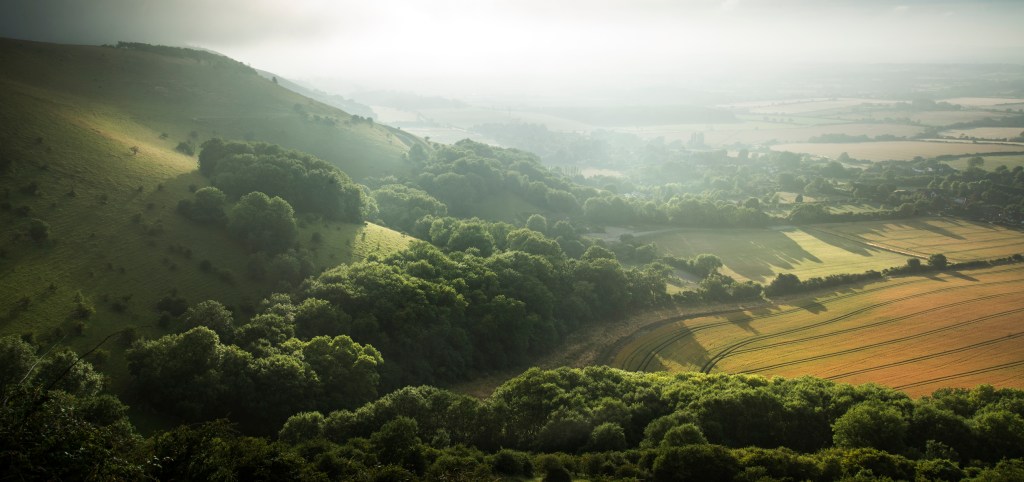
The wood grows around us. It becomes aware of us, too. There’s a small fawn in the opening of the hill; watchful. We find our bearings, the path and its directions all becoming too similar; there’s a moment, quickly missed, when you can too easily lose your way. The path starts downward. The trees ahead open and, like a frame, it spies out into the South Downs. In its heights, you witness these kinds of views or, perhaps more wishfully, panoramas – you can see further, deeper, more widely. In the middle of this steeping path there’s a piece of casual history, a rite of visitation, a spot for local tourism: the poet’s stone, so it goes. This “stone” has a storied history, in dedication to Edward Thomas, and these views, I believe, have been musing the many visitors for years.
A hillside picnic. Restful is this feeling of watching the views.
The old-world lives here in Steep. There are cottages in neat rows. The brooks babble. Roses age on thick bindings and sharp thorns. Somewhere in these parts of the wood, where an easy river runs, there have been recorded sightings of a Kingfisher. We try to spy the bird, quietly watching our reflections in the river.
June 6. | Up & Down.
I track our walk now. I research them, too. If walking is a hobby, I’d peg myself a hobbyist of touring these parts of the countryside. Walking, I say, meaning a kind of process of discovery. It’s often the topic of conversation in these parts – the range of sights and sounds. It’s truly binding people together in this moment of temporary disruption.
There are several roads nearby with quirky namings. It’s the fodder for fiction, ideal for every inch of a children’s novel, possibly a travelogue, or the kinds of realms explored in some twee British fantasy. Badger’s Holt. The Ridings. I take my notebook this time, carefully remarking on the scenery.
Lanes multiply; hideaway houses are far from any mapped road. We follow the path until we reach the higher end of the hillside, across a busier part of the village, and then we recede back into the woods. The forest invites you. It’s tall and wide and a grey sky clings to it from above. It’s almost menacing. We walk down a path and the woods holds close to its illusion of threat – one of us jokes that it feels like a horror movie. There are empty huts of tied wicker and wood, presumably a retired campsite from a few days ago. Any noise drops and it picks up an echo. Sound blurs against the ranks of trees.
We reach the ending of the woods, where the path thins and spirals out into an earthy burrow of wicker and banks of of something sweetly-smelling. On either side of us, farms spread uninterrupted. A low and heavy wind holds us against the path. It’s only a straight walk, nothing taxing, and within another hour the banks of low tree and hazel crumble to new views. I’m not sure what I’m seeing, or where to find it on a map.
The path moves through a small clot of trees like a tunnel. There’s a small cafe and resting nook on the farm up ahead, which is welcoming the thin ranks of visitors. We order a slice of carrot cake and a coffee. This is our first contact in a while, our first experience with a “public” space, though few people are here.
We sit. We watch. We remember the good times.
 cainebird.com